How Axkid calculates product carbon footprints
At Axkid, safety has always been our top priority, and now, transparency is part of that promise. We publish Environmental Product Declarations (EPDs) for all major Axkid products so you can see verified data about their environmental impact. This doesn’t mean our products are fully sustainable or carbon neutral, it means we want you to have clear, reliable information to make informed choices.
Carbon footprints can be complex and easy to misunderstand. That’s why we are sharing how we calculate these numbers, what they mean, and what they don’t. Our goal is to explain the facts in a way that’s easy to understand, without exaggeration or hidden details.
Why emissions matter
Caring for children today also means thinking about their future. Carbon emissions contribute to climate change, which affects the world they will grow up in. By measuring and sharing our product footprints, we aim to provide transparency and encourage progress. This is not about claiming full sustainability, it’s about giving you clear, verified information that matters.
What is a product’s carbon footprint?
A product’s carbon footprint is the amount of greenhouse gases released during its life cycle, expressed as CO₂e (carbon dioxide equivalent). This common measure makes comparisons easier and more accurate. The figures we share represent emissions for specific life-cycle stages, so you know exactly what they cover.
How do we calculate it?
We use Life Cycle Assessment (LCA), a globally recognized method that looks at every stage of a product’s life from raw materials to assembly, distribution, and recycling. Our calculations follow international standards and are verified through EPDs. LCA results depend on the scope chosen. We focus on Cradle-to-Gate (from raw materials to factory exit) because it’s the most common and easiest to compare. This does not include transport, use, or end-of-life stages, these are however stated in the EPD.
EPDs: transparency you can trust
Our EPDs are standardized, audited documents that verify calculations according to international norms. Independent verification ensures accuracy and comparability. Publishing EPDs does not make a product carbon neutral, it makes the data trustworthy and comparable.
Key figures from our LCAs
Our main products have a carbon footprint ranging from 60,5 to 100 kg CO₂e in a Cradle-to-Gate scenario and recycled material content between 18% and 33%. Full life-cycle data is available in the EPD documents linked below.
| Life cycle scope / Data type | Product weight | Cradle-to-Gate | Cradle-to-Grave | Cradle-to-Cradle | Recycled content |
| Description | Excluding packaging | Scope: Manufacturing | Scope: Manufacturing, distribution, use, and disposal | Scope: Cradle-to-Grave + recycling | Secondary materials used |
| Value type | Net weight | GWP fossil | GWP fossil | GWP fossil | Weight % |
| Unit | kg | kgCO2e | kgCO2e | kgCO2e | % of product net weight |
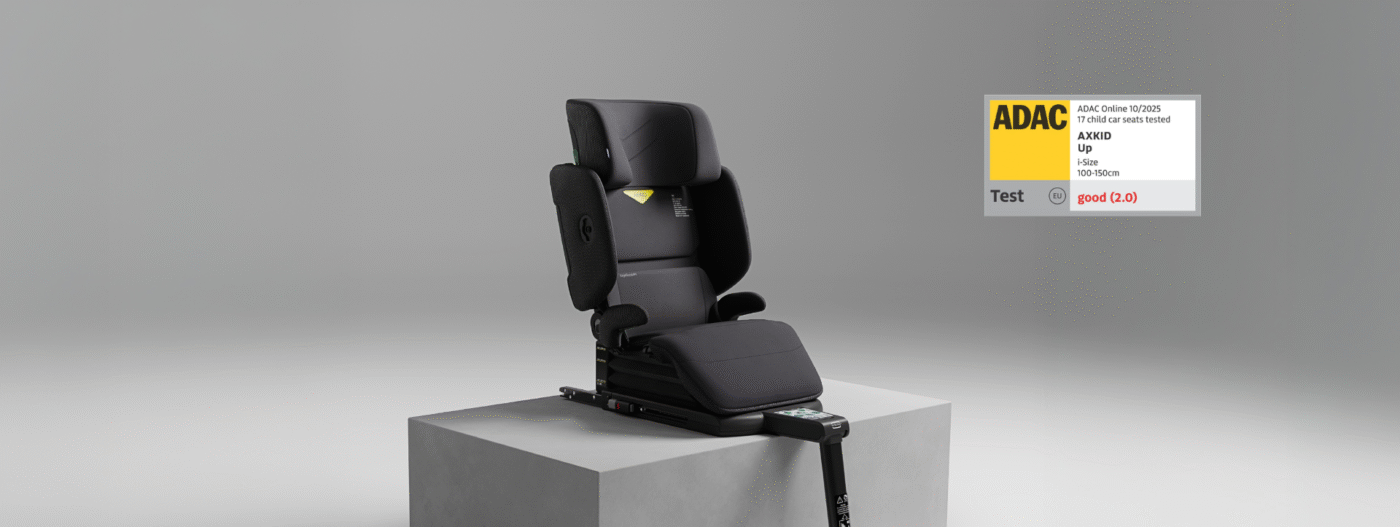
| Axkid UP | 9,54 | 60,5 | 72,3 | 67,4 | 33% |
| Axkid One 3 (average) | 10 | 97,8 | 109,1 | 92,9 | 31% |
| MK4 Max | 10,9 | 70,5 | 89,0 | 87,8 | 23% |
| MK4 Pro | 9,5 | 61,5 | 79,2 | 78,3 | 18% |
| Spinkid 2 | 15,1 | 100,0 | 123,5 | 109,6 | 23% |
Notes: Axkid one 3 is calculated as a volume weighted average of One 3 and One +3. Use stage is calculated as zero for all products. GWP fossil numbers are shown as this is the most common approach. See links for direct access to the actual EPDs containing all data.
Our EPDs are available on EPD hub through the links below:
Axkid Minikid 4 Max on EPD-Hub
Axkid Minikid 4 Pro on EPD-Hub
Why do footprints vary?
Product emissions can differ a lot depending on what the product is and how it’s made. For child car seats, comparisons are difficult since most brands don’t publish emissions data. The biggest factors influencing emissions in a conventional child car seat are product weight, the types of materials used, and the way each item is produced. Different materials emit different amounts of CO₂ per kilogram. Materials like aluminum and electronic components generally add more to a product’s carbon footprint. In practice, the total footprint is calculated by multiplying the weight of each material by its specific emission factor.
Product lifetime: A factor to consider
Axkid One 3 and Axkid Up are designed for durability, with a lifespan of up to 15 years compared to the typical industry standard of 10 years. We share this information because we believe a longer lifetime means more children can use the same seat before it needs to be replaced, which can help reduce the need for additional products over time.
Our life cycle assessments (LCAs) focus on emissions from manufacturing and do not calculate emissions per year of use or include lifetime as a factor. This is common practice and ensures easier comparisons between products. While lifetime isn’t reflected in the footprint figures, it’s an important consideration when thinking about overall resource use and product value.
Reducing emissions: our next steps
Sharing this data is an important milestone, and it’s just the beginning. We’re actively working to lower our impact by setting clear reduction targets, increasing the share of recycled materials, and collaborating with suppliers to improve processes. Every step is focused on making meaningful progress without compromising safety or quality.
What consumers should know
These figures give you verified data on emissions and recycled content for comparison, however this is not a full measure of sustainability. When choosing products, durability and proper recycling at end-of-life can make a real difference. For complete details and full life-cycle information, refer to the EPD documents.
In short
We believe transparency builds trust. By publishing EPDs, we’re not claiming perfection, we’re showing the facts and inviting you to join us in making informed choices.