Why Forward-Facing Car Seats Need 55cm for Safety
We have all this data proving that rear-facing for as long as possible is the safest option for a child. Yet, many parents still choose forward facing car seats before the child is ready, purely out of convenience.
One common misconception is that rear-facing car seats take up more space than forward-facing ones. But did you know that a forward-facing car seat requires 55 cm from your child’s car seat to the seat in front? This is called the “survival gap” and highlights the significant space requirement for a forward-facing car seat. Therefore, the forward-facing car seat might not be as space efficient as you might think.
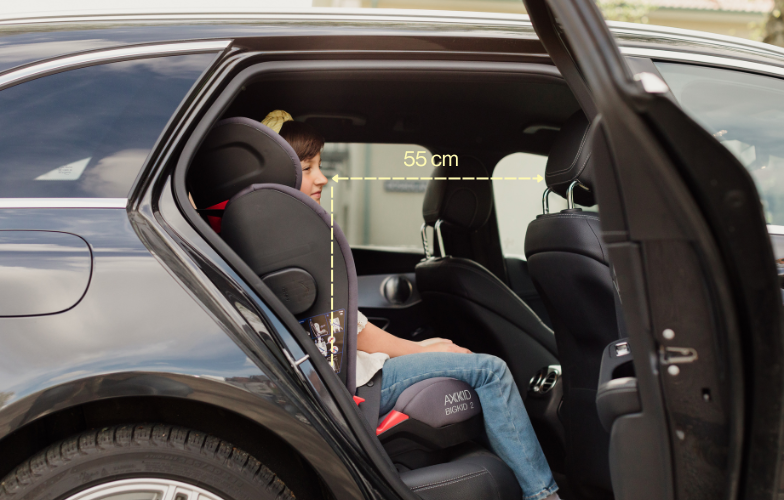
The survival gap is measured between the child’s nose and the closest point of the seat in front, measuring at least 55 cm (see image).
It is important that these recommendations are followed to ensure that your child sits safely in their forward-facing car seat. The child should be able to bend the entire upper body forward without touching the seat in front, as this is what happens in a collision. The child can usually achieve this when the distance from the child’s nose to the nearest point on the front seat is at least 55 cm. Therefore, the deployment of the Survival Gap is considered crucial in the event of an accident as it prevents your child from hitting their head on the front seat and reduces the risk of serious head and leg injuries.
Why it is important not to turn to early
The decision to switch from rear-facing to forward-facing should depend on the individual child’s size and development. At Axkid, we recommend that your child travels rear-faced up to 6-7 years of age. However, the child’s length is often what determines when it is time to make the transition to forward-facing. Ideally, this switch should occur after the child has passed 125 cm in height.
Conclusion
Understanding the importance of the survival gap is crucial to prevent a child from experiencing forces upon impact or sudden breaking. Hence, it should not be ignored if you wish to keep your child safe when travelling forward facing.
Many parents believe that rear-facing seats take up more space than forward-facing ones. The reality is that forward-facing seats require a 55 cm to achieve optimal safety – a standard that the Minikid 4, with its compact design, meets.
Travel safe. Travel rear-faced for as long as possible. It’s up to 5 times safer!